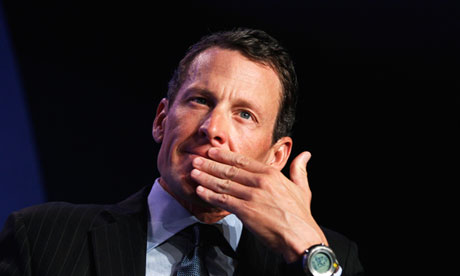
The Armstrong Lie – A Review.

In 2009, seven time Tour de France winner Lance Armstrong
announced his return to competitive cycling with the sole aim of taking part in
that year’s edition of the famous road race and, ultimately, winning it. One
man who followed him every step of the way was film director Alex Gibney, who
was intrigued by this man's “miraculous” return to the sport he had previously
dominated for the better part of a decade. What was going to be a positive
appraisal of Armstrong’s comeback, indeed the working title of the documentary
was called “The Road Back”, quickly turned on its head when the doping
revelations and subsequent confessions sent the legendary cyclist’s reputation
into free-fall. Gibney went back to face Armstrong in 2012 to demand answers as
to why he kept up his lie for so long.
Gibney mixes his original footage from the 2009 season,
starting with Armstrong’s comeback announcement in the January right through to
the culmination of the Tour de France, with interviews of Armstrong pre and
post confession, along with interviews from a host of other names within
cycling who either worked with, pursued or testified against the Texan. Most
specifically, he speaks to George Hincapie, former teammate of Armstrong and
the Andreu’s, Frankie and Betsy, who were pivotal in Armstrong’s eventual
downfall. However, the most interesting (to cycling fans at least) of the interviewees
is Dr Michele Ferrari, a man with a notorious reputation with being hard to get
a word out of. Though the interviews take place in a time where Armstrong’s
name isn’t being dragged through the mud, you can tell why Ferrari avoided
media attention whenever he could. Maybe it’s just the cynic in me who holds
him partially responsible for cycling’s inherent problem with doping, this is the
man that taught Armstrong how to do it after all, but he just gives off an air of
shadiness, like there was something more he knew about but didn’t want to let on.
 |
| Michele Ferrari - Armstrong's doctor and doping mastermind |
The documentary builds Armstrong up purely to tear him down
with consistent ease. He goes from all conquering cancer survivor to doper
extraordinaire, from a charitable, good intentioned patron to a meticulous and
malicious bully. But herein lies the fundamental problem with the film. It
doesn’t know what it’s trying to be. It’s obvious that Gibney, like many others,
was a huge Armstrong fan and like many of us, he’s also probably struggling to
comprehend the web of lies that he spun. But in constantly flipping from good
to bad Lance, you are torn between empathy and disgust for him. The film’s
title, the interviews, all of them point at you hating Armstrong, but the film
just doesn’t allow you to do that.
| Armstrong donning his foundations' colours |
As a cycling fan, I was also disappointed by the lack of
revelations that the film exposed. Besides one part referring to his climb up
Mount Ventoux on his comeback, there was nothing ground breaking regarding his
confession or “lies” about his return. Though I will admit that I may be being
harsh as I’ve kept as close an eye as anyone on this story and know my
research, I was still surprised that a man who spent such an extended period of
time in close quarters with someone like Armstrong, and with all the interviews
he sought, didn’t rumble anything new. That said, if you were just a casual
observer or not a die-hard fan of the sport, then this film does actually offer
quite a well-rounded view of how Armstrong’s lie “unraveled”. 2009 also happened
to be Bradley Wiggins’ “break out” Tour de France, so there’s a fair smattering
of him in the documentary too, for the British observer.
In the end, The Armstrong Lie offers viewers a 129 minute
look at a man’s legacy that spans nearly 20 years, from the moment he races
professionally for the first time, to his legacy’s peak and reign on top of the
cycling world, and to ultimately, the demise of that legacy with the USADA
findings in August 2012. Gibney does a great job in making the documentary accessible
and engaging throughout and by keeping a constant thread, no mean feat
considering this was going to be an entirely different film to begin with.
Though lacking the hard hitting punch that some fans are craving, it’s still a
good biopic of a man who, as the film puts it, “simply wanted to win too many
times.